A Therapist Goes To The Movies
I recently gave a talk on Alfred Hitchcock’s 1941 psychological thriller Suspicion, starring Cary Grant and Joan Fontaine.
This classic film, set in 1930s England, explores themes of authority, marriage, doubt, and the fine line between suspicion and madness.
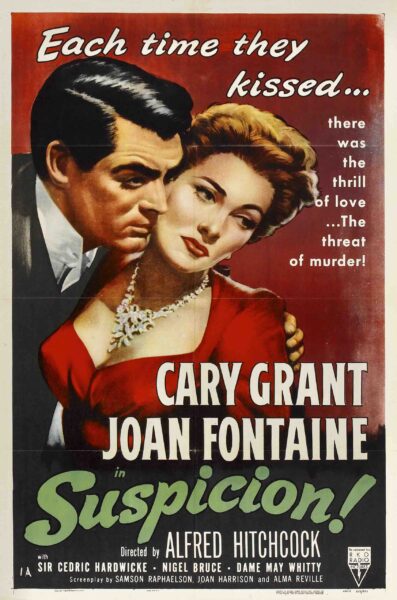
Hitchcock’s Suspicion follows Lina (Fontaine), a single woman who impulsively marries Johnny (Grant), a charming yet unreliable man.
As the marriage progresses, Lina begins to suspect that Johnny may be plotting to kill her.
As the movie’s publicity poster dramatically proclaims:
Each time they kissed… there was the thrill of love… The threat of murder!
Contingency or When Chance Alters Destiny
The film begins with a chance encounter on a train. Lina, engrossed in a textbook on child psychology, is interrupted when Johnny enters the compartment and asks to borrow change to buy a ticket from the inspector.
As she opens her purse, he notices a postage stamp worth the exact value of the ticket and hands it to the inspector.
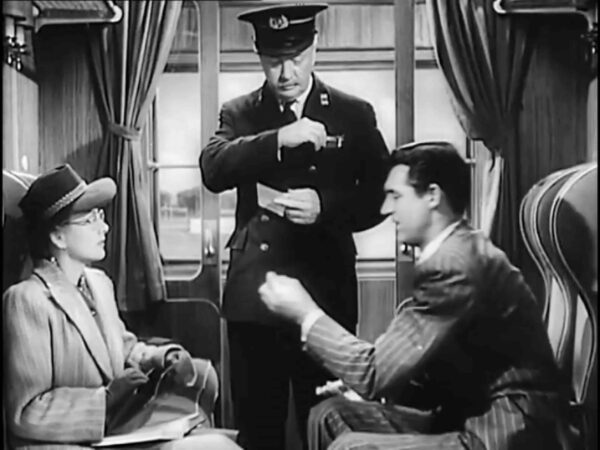
This seemingly trivial moment profoundly alters their life trajectories, highlighting the role of contingency in shaping our experiences and decisions.
This theme also serves as a pivot in other Hitchcock films, such as Strangers on a Train (1951), where a casual meeting between two strangers leads to a deadly pact.
A Father’s Judgment and Lina’s Desperation
Later, when returning home after an awkward first date—which ends with her snapping her purse shut—Lina overhears her father discussing her future,
FATHER: Lina will never marry, she’s not the marrying sort…
MOTHER: I suppose you’re right, dear. I’m afraid she is rather spinsterish.
FATHER: Well what’s wrong with that? The old maid is a respectable institution. All women are not alike…
Suddenly confronted by the question of what women want—and her father’s assertion that she is destined to remain unmarried, to become an ‘old maid’—Lina appears confused, distracted, and anxious, caught in a bind.
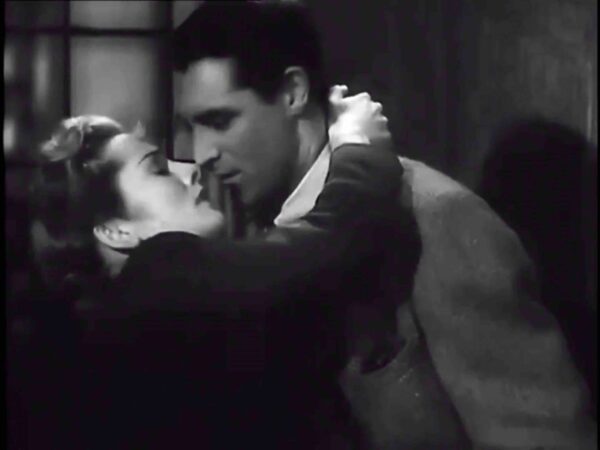
In a desperate attempt to escape this overwhelming state, Lina turns to Johnny (who is now next to her) and, in an impulsive act, kisses him for the first time before abruptly exiting the scene.
What Kind of Kiss Is This?
Lina’s kiss is neither romantic nor tentative, and Johnny doesn’t expect it, nor does he have time to respond.
Instead, her kiss is abrupt, decisive, and sure—an action that instantly distances her from her father’s satisfaction.
Her kiss constitutes her as the marrying sort, catapulting Lina beyond the paternal authority that had previously defined her social and mental existence.
This is a moment at which her destiny shifts from one track to another. Her kiss, therefore, is also a desperate act—its consequences cannot be known in advance.
In therapy terms, this moment can be understood as a passage through the act.
What Is a ‘Passage Through the Act’?
The term has its origins in French criminology and psychiatry, where it was used to describe impulsive, often violent acts.
A passage through the act occurs when someone, faced with an unbearable combination of embarrassment and anxiety, makes an impulsive move that permanently alters their trajectory.
It may not only force a shift in identity, a relationship, or a situation but can also extend to the ending of a life.
Within the therapy literature, there are two much-discussed examples of a passage through the act:
• Young Dora’s slap across the face of the man who confessed his lack of interest in his wife.
• The jump from a bridge by another young woman following her father’s disapproving look when she is seen with the woman she loves.
(The young woman paid for this serious attempt to end her life with a long recovery in bed, though fortunately, she suffered little permanent damage.)
A passage through the act is both a rupture and a resolution—a way of escaping an intolerable situation. But it is also irreversible.
Lina cannot return to the moment before the kiss; she has changed the course of her life.
Working Through the Consequences
The next few scenes show Lina ‘working through’ what it means to have become the ‘marrying sort.’
They culminate in a striking scene: Johnny proposes to Lina in front of a portrait of her father.
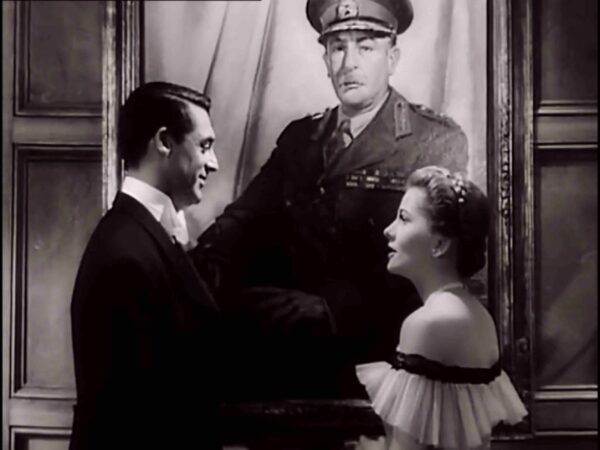
In a darkly comedic Hitchcockian twist, the portrait suddenly falls from the wall—the final collapse of the symbolic function of the father.
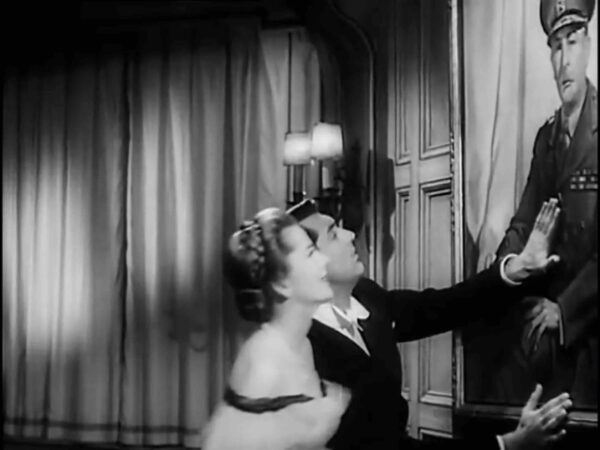
Lina, undeterred, tells Johnny: it doesn’t matter, it doesn’t matter.
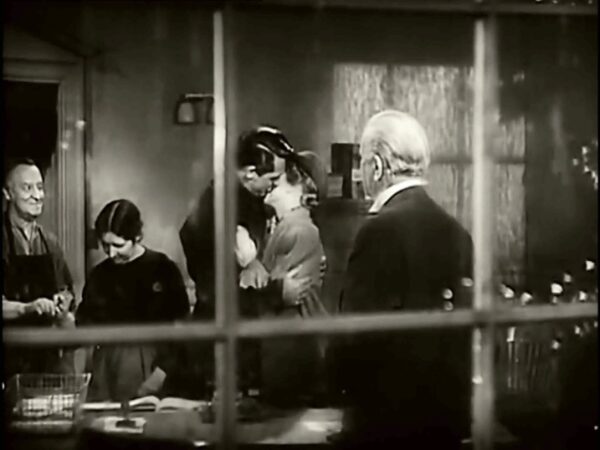
Soon after, they elope, glimpsed through the rain-spattered window of a Register Office as they marry.
From Doubt to Suspicion
The film continues by exploring the consequences for Lina of the gap that opens up following the collapse of her father’s authority and Johnny’s inability or unwillingness to adopt this symbolic role.
The collapse, it turns out, does matter after all.
Lina’s doubts about Johnny and her marriage are increasingly transformed into terrifying suspicions that he intends to harm her—even to murder her.
The film alternates these suspicions with moments of relief, as proof arrives that her fears may be mere projections, but leaves open the question of whether Johnny truly intends to harm her.
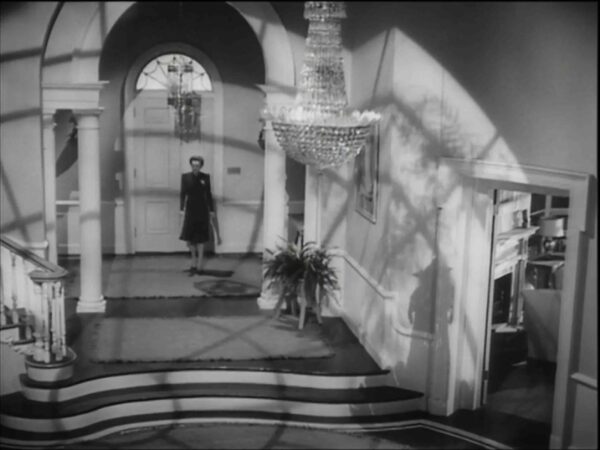
Lina, caught in a web of suspicion
Notes to the Blog
My talk, Beyond Doubt: Alfred Hitchcock’s Lina, was given to the North West Regional Psychotherapy Association on 12 April 2019.
Were Lina to remain ‘not the marrying sort,’ perhaps an alternative answer to what she wants might be to enter a same-sex relationship, perhaps like the couple she dines with later in the movie, rather than becoming the ‘old maid’ advocated by her father.
Passage to – rather than through – the act is the usual translation of the French passage à l’acte, borrowed by psychoanalysis from French criminology and psychiatry.
The two much-discussed examples in the therapy literature are case histories by Freud: Dora (1905) and The Psychogenesis of a Case of Homosexuality in a Woman (1920).
Judith Butler might describe Lina’s new identity as performatively constituted by the very ‘expression’ – a kiss – that is said to be its result. See her Gender Trouble.